
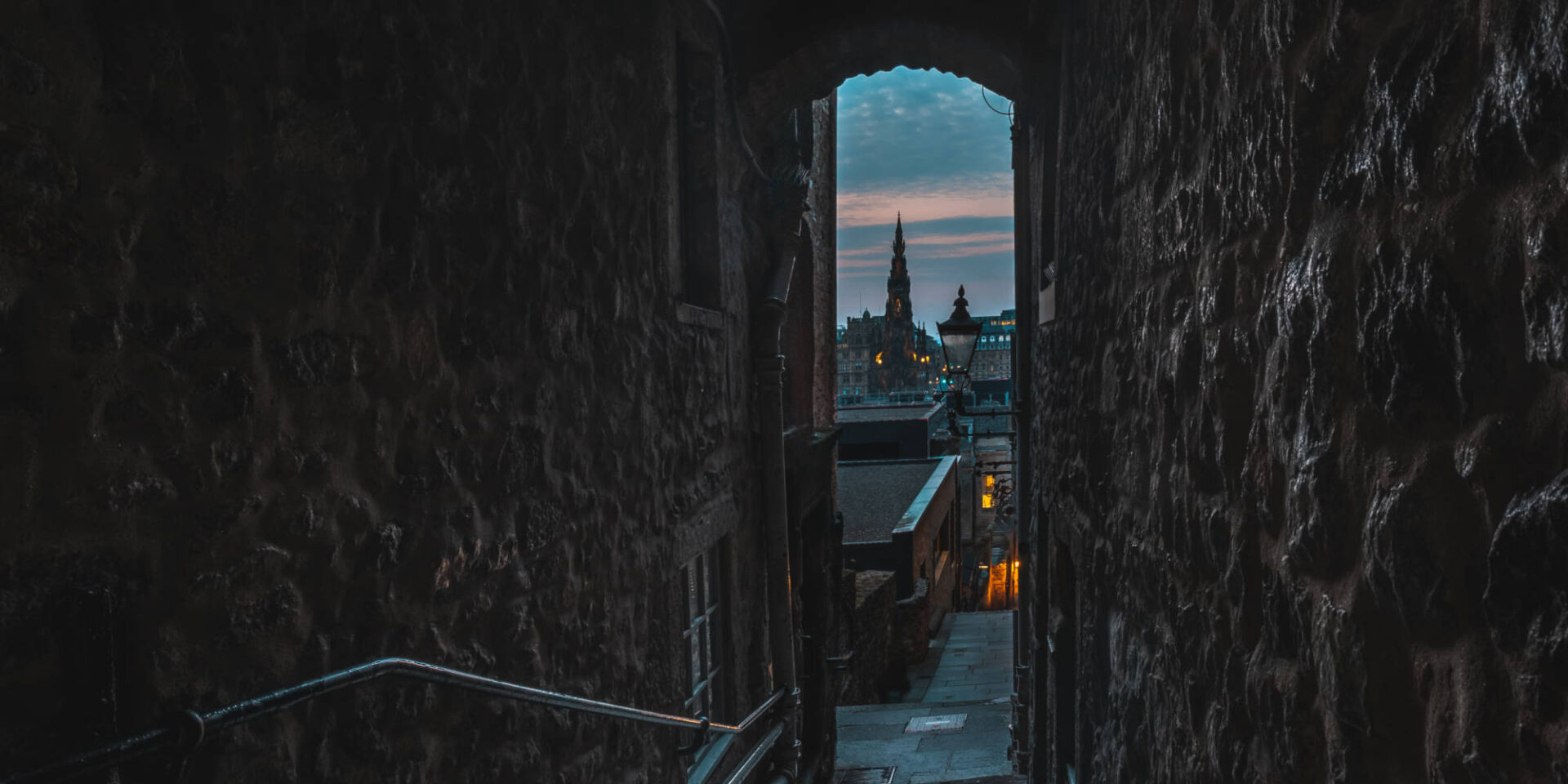
What are the Edinburgh closes?
In Edinburgh’s Old Town, particularly leading off the Royal Mile, there are several narrow alleyways and passageways. These are called closes, or sometimes wynds, entries or courts. With signs at the entrance such as Fleshmarket Close and Advocate’s Close, their unusual names make them even more intriguing. They were often named after prominent residents or trades that took place there. Close derives from the fact that they were usually closed, dead-end alleys. As opposed to a wynd (thoroughfare), a court (courtyard), or an entry (access point).
Closes are a defining feature of the medieval layout in the oldest parts of the city. At one time, residents would have been densely packed into these narrow streets and alleyways, and there are many stories that surround them. Here are some of the most famous ones…
Mary King’s Close
This close was once a busy street with shops and houses. It was named after business woman, Mary King, an occupant in the 1600s. In 1753, a new building was constructed on top of the close and several others, partially burying them and closing them to the public. The lower parts of original buildings were preserved beneath, and later excavated in the early 2000s. These fascinating closes are now open to the public as a tourist attraction, The Real Mary King’s Close. Here, you can take a historical tour to learn more about life on the Edinburgh closes.
Advocate’s Close
With a steep descent, this stepped close leads from Market Street to the Royal Mile. The name comes from the Lord Advocate of Scotland, whose house was located there. There were once many buildings on the west side of the close, which were removed in the 1920s, revealing a framed view of the Scott Monument from the Royal Mile. The area underwent an extensive but sympathetic redevelopment in the 2010s, which retained this remarkable view. Half way up the close, you can visit The Devil’s Advocate, an atmospheric bar and restaurant, converted from an old Victorian pump house.
Paisley Close
This narrow alley has a striking doorway portrait and inscription, representing the story of a young boy on the close. In 1861, a tenement building above the street collapsed, burying its residents under rubble. Rescuers worked desperately to find survivors, and just as hope was fading, they heard a young boy’s voice cry out Heave awa’ chaps, I’m no’ dead yet! (Heave away men, I’m not dead yet!). The boy, Joseph McIvor, was miraculously pulled from the wreckage and his words became legendary. At the request of the flat’s proprietor above, an inscription of the famous phrase was later carved above the entrance, along with a relief of his face.

Fleshmarket Close
Fleshmarket Close was once home to a thriving meat market. An abattoir stood at the bottom, while the market itself was held at the top, where the close met the bustling High Street. Butchers would hang meat along the street, and blood would run down the steep slope towards the Nor’ Loch (North Lake), a man-made body of water that has since been replaced by Princes Street Gardens. Fleshmarket Close is also the name of a crime novel by writer Ian Rankin, part of his Inspector Rebus series, which is set in Edinburgh.
Bakehouse Close
This name comes from the bakeries that once operated on the close. One of its points of interest is Acheson House, a 17th-century townhouse built for Sir Archibald Acheson, a former Secretary of State for Scotland. In recent years, it has gained recognition as a filming location for the Outlander TV series, where it became the setting for an old-fashioned print shop. The close’s atmospheric, cobbled passageways make it a picture-perfect spot, taking you back in time to the 16th century.

Brodie’s Close
Brodie’s Close takes its name from the Brodie family, who were once respected tradespeople in Edinburgh. However, among them was William Brodie, better known as Deacon Brodie, whose secret double life would later inspire Robert Louis Stevenson’s Strange Case of Dr. Jekyll and Mr. Hyde. Deacon Brodie was a trusted cabinetmaker and city councilor by day, but a thief by night. To fund his lavish lifestyle, Brodie used his position to copy keys and later rob the very houses and businesses he worked in. He was eventually hanged at the Tolbooth Prison. Today, there is café named Deacon’s House by the entrance to the close and a pub called Deacon Brodie’s Tavern, opposite.
Dunbar’s Close
Dunbar’s Close is named after a solicitor and writer, David Dunbar, who owned the buildings around it in the late 1700s. It leads to one of the city’s hidden gems, a quiet formal garden just off the bustling Royal Mile. Tucked away behind the close, Dunbar’s Close Garden is designed in a 17th century style, although it was actually created in 1979. The garden is free to enter and provides a peaceful escape from the busy city.

This is just a snapshot of the many fascinating closes in Edinburgh. With over 80 of these surviving passages and alleyways, there’s plenty to discover as you wander through the Old Town. A fun way to explore them is by following the Edinburgh Old Town & Landmarks Treasure Trail. This engaging scavenger hunt guides you along the Royal Mile and into several closes and wynds, encouraging you to look for details you might otherwise miss.


