
What are the seven hills of Edinburgh?
The historic city of Edinburgh is said to be built on seven hills, in a nod to the famous Seven Hills of Rome. Edinburgh does indeed have many hills, and there is some debate over which ones should be counted among the seven. So let’s take a closer look…

The traditional seven hills
A running race and challenge called the Seven Hills of Edinburgh has been held annually since 1980. The route takes in seven hills around the city and these are known as the traditional seven.
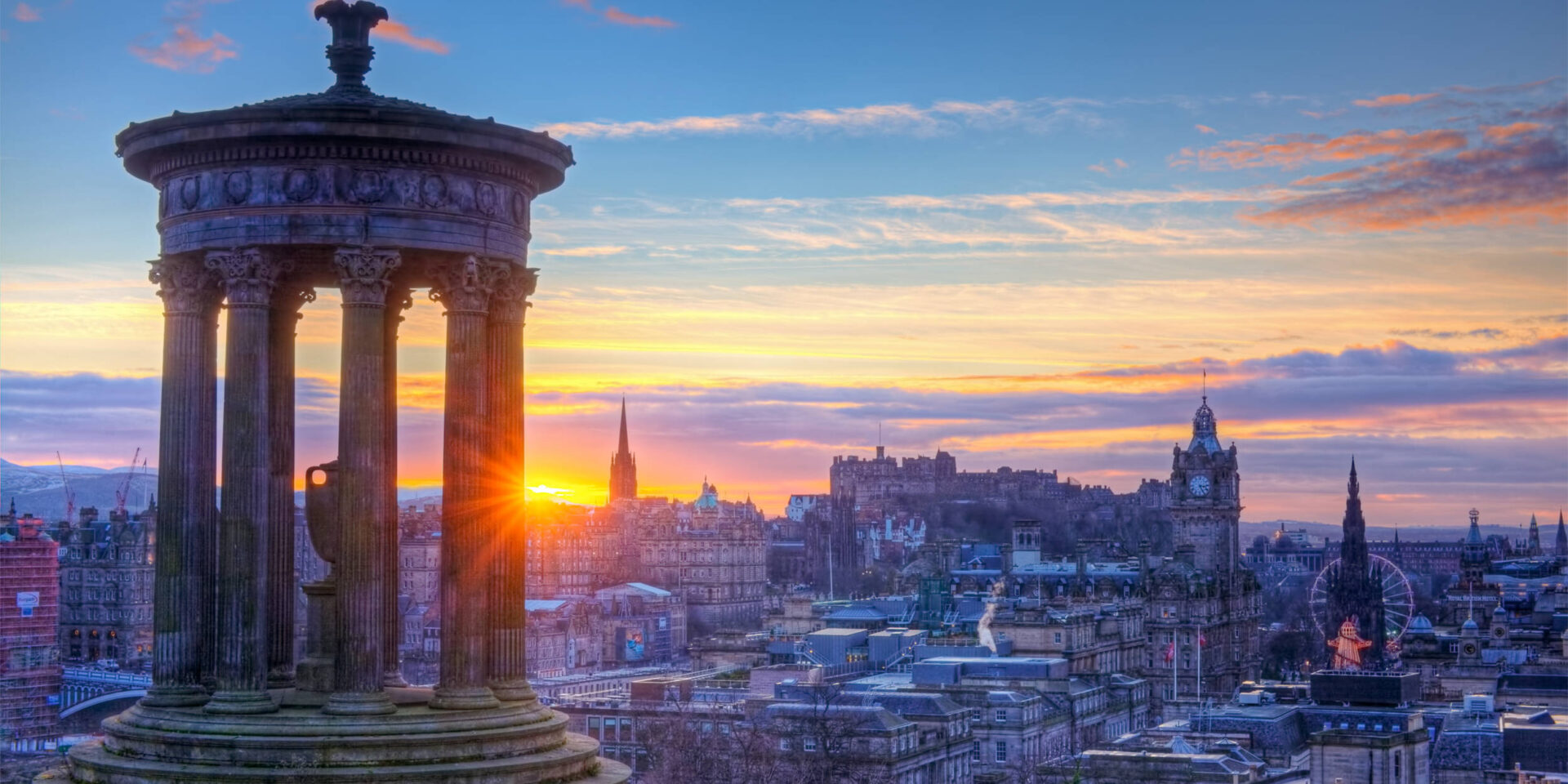
- Calton Hill – A prominent hill in the city skyline, offering stunning panoramic views of Edinburgh Castle, Arthur’s Seat and the Firth of Forth. It’s famous for its collection of historic monuments and landmarks, such as the National Monument, Nelson Monument, City Observatory, Dugald Stewart Monument, Burns Monument and the Portuguese Cannon.
- Castle Rock – Castle Rock is an extinct volcano that serves as the foundation for Edinburgh Castle. Formed around 350 million years ago, it rises 130 meters above sea level, providing a natural stronghold that has been a strategic defensive location for centuries. The castle has witnessed pivotal events in Scottish history, including battles, sieges and royal ceremonies. It is one of Edinburgh’s most iconic landmarks.
- Corstorphine Hill – This hill provides lush green spaces and scenic views, and is popular for walking and outdoor activities. Located in the western part of Edinburgh, it is covered in woodland and is a designated nature reserve, home to various wildlife. At its summit, you’ll find Corstorphine Hill Tower, a monument to Sir Walter Scott, which is occasionally open to the public to climb.
- Craiglockhart Hill – Craiglockhart Hill in the southwest of Edinburgh has two peaks: Easter and Wester Craiglockhart Hill. Here you can enjoy several scenic walking paths. It is part of a local nature reserve, rich in wildlife and plant species.
- Blackford Hill – To the south of the city, this hill is part of the Hermitage of Braid and Blackford Hill nature reserve, which provides a habitat for diverse wildlife. The hill is also home to the Royal Observatory, a unique scientific centre for astronomy. Blackford Hill attracts walkers, runners and birdwatchers to its hillside trails with amazing city views.
- Arthur’s Seat – Another extinct volcano, standing at 251 meters and giving breathtaking views of the city and beyond. Within Holyrood Park, it is the highest point in the park and a very popular destination for walkers. The summit is accessible via various trails, making it a favorite location for both locals and tourists.
- Braid Hill – Part of the picturesque Braid Hills, a range of low hills that provide a peaceful retreat for walkers, runners and golfers, as it is home to the Braid Hills Golf Course. The area is rich in natural beauty, with grassy slopes, woodlands and wildlife. When it snows, it becomes a popular spot for families, who use its slopes for sledging.

The seven hills poem
There is an old poem, which suggests a different set of seven. As above, it includes Calton Hill and Castle Rock. Also Abbey, which may refer to Abbeyhill, the area around Arthur’s Seat. But it also adds St Leonard’s, St John’s, Sciennes and Multrees. These are well-known parts of Edinburgh, but aren’t really thought of as hills, perhaps due to the way the architecture and landscapes have changed over the years. However, the references are there in the street names; St Leonard’s Hill, St John’s Hill, Sciennes Hill Place and Multrees Hill (now Multrees Walk).
“Abbey, Calton, Castle grand,
Southward see St Leonard’s stand,
St John’s and Sciennes as two are given,
And Multrees makes seven”

These are the two most popular theories for which hills are included in the seven hills of Edinburgh, although the debate continues. Climbing some or all of the traditional set is a fantastic experience during a visit to Edinburgh, and you’ll be rewarded with some spectacular views of our beautiful city.


